Breathing trouble is one of the most frightening things a family can see at home. An elderly father with COPD whose lips start turning blue, a mother with asthma who can’t finish a sentence, a patient with pneumonia whose oxygen reading keeps dropping, or someone who uses home oxygen and needs to reach hospital. In each case, the patient needs oxygen on the way, not a ride in the back seat of a car. That’s what an oxygen ambulance is for. This guide explains how an oxygen ambulance in Rawalpindi and Islamabad works, when to call one, what to tell us, and how to keep the patient safe until they reach hospital.
Need one now? Call 0336 291 4741 or 0345 570 4719, or send a WhatsApp message with your location pin. We answer 24/7.
What is an oxygen ambulance?
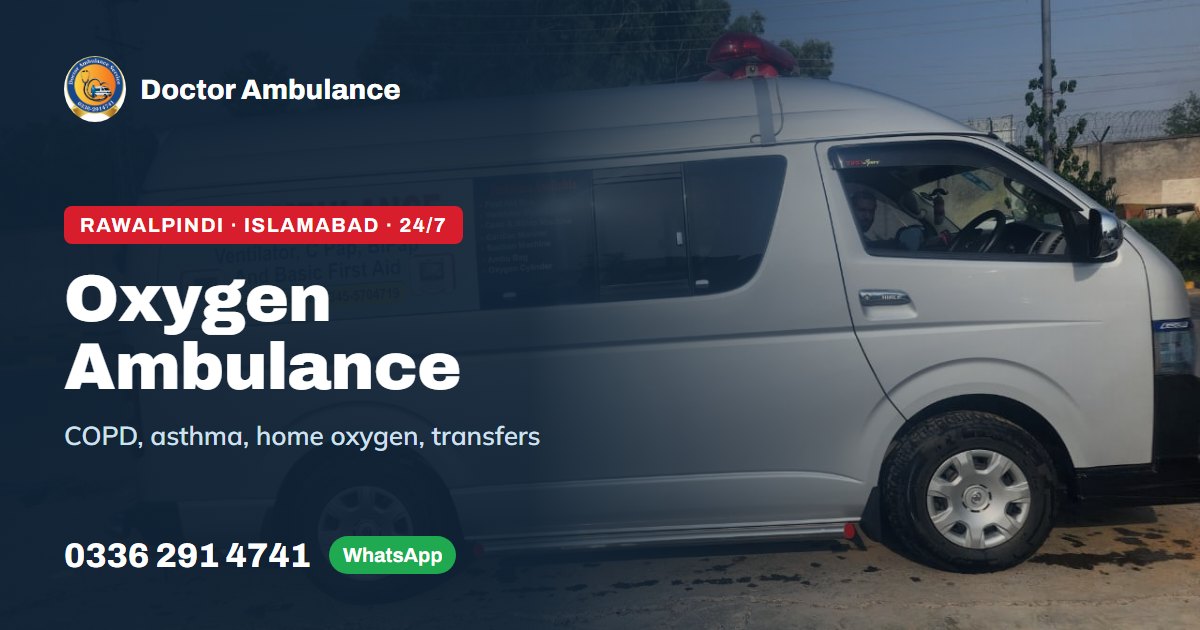
An oxygen ambulance is an ambulance with oxygen supply on board, set up to give the patient oxygen for the whole trip. It carries oxygen cylinders, masks and nasal tubes, a pulse oximeter to check the oxygen level, and a stretcher so the patient can lie down or sit propped up, whichever helps them breathe. Trained staff travel with the patient, watch their breathing and oxygen level, and adjust the oxygen if needed.
It sits in the middle of the ambulance types we run. A basic ambulance is for stable patients who don’t need oxygen. An oxygen ambulance is for patients who need oxygen but are breathing on their own. An ICU or ventilator ambulance is for critical patients who need close monitoring or a machine to help them breathe. Our guide on which ambulance you need explains all three in plain words.
When to call an oxygen ambulance
Call for an oxygen ambulance when the patient is short of breath, or already needs oxygen, and has to get to a hospital or move between hospitals. Common situations in our calls include:
- Asthma attack that doesn’t settle with the usual inhaler
- COPD flare-up in an older patient, often in winter or after a chest infection
- Pneumonia or a bad chest infection, with fast breathing and fever
- Heart failure with breathlessness, especially when lying flat
- A patient on home oxygen who needs to go to hospital for a check-up, a scan or admission
- Discharge of a patient who still needs oxygen at home
- Hospital to hospital transfer of a patient on oxygen
- Long-distance trips, where even a mildly breathless patient may need oxygen for safety
Warning signs that need help now
Some signs mean the patient needs help straight away. Don’t wait to see if they settle:
- Lips or fingertips turning blue or grey
- Struggling to speak a full sentence
- Using neck and shoulder muscles to breathe, or ribs pulling in
- Confusion, drowsiness or unusual restlessness
- A pulse oximeter reading that is falling, or well below what is normal for that patient
- Chest pain together with breathlessness
If the patient stops breathing normally, call for help and start CPR. Our guide on first aid before the ambulance arrives covers the basics. If you think it’s a heart problem, read our guide on the ambulance for heart attack patient.
Oxygen ambulance in Rawalpindi
Our base is at Chandni Chowk on Murree Road, in the middle of Rawalpindi, so we cover the whole city: Saddar, Satellite Town, Westridge, Chaklala, Bahria Town, DHA and the areas along Murree Road, Peshawar Road and Adiala Road. Families in Rawalpindi often take breathless patients to Benazir Bhutto Hospital, Holy Family Hospital, the District Headquarters Hospital, or the Rawalpindi Institute of Cardiology when the heart is involved, as well as private hospitals across the city. Our list of hospitals in Rawalpindi has their main phone numbers. For everything else we do in the city, see our main page on ambulance service in Rawalpindi.
Oxygen ambulance in Islamabad
We cover every sector of Islamabad, from the G and F-sectors to E-11, I-8, Bani Gala and the Expressway. In the capital, families usually choose PIMS in G-8, the Federal Government Polyclinic in G-6, or Shifa International in H-8, along with private hospitals in the F-sectors and Blue Area. Our list of hospitals in Islamabad has their main numbers. For all our services in the capital, see our page on ambulance service in Islamabad.
How to book an oxygen ambulance
- Call or WhatsApp 0336 291 4741. If it’s busy, call 0345 570 4719.
- Give the address and send a WhatsApp location pin.
- Describe the breathing: how fast, how bad, and since when. Tell us the oxygen reading if you have a pulse oximeter.
- Tell us about home oxygen: whether the patient already uses it, and the flow rate the doctor has set.
- Tell us the hospital you want, or ask us to help you choose.
Say “oxygen” clearly on the call so we send the right vehicle. If you’re not sure whether the patient needs an oxygen ambulance or an ICU ambulance, describe them and we’ll suggest the safer option.
While you wait for the ambulance
- Sit the patient upright or propped on pillows. Most breathless people breathe more easily sitting up than lying flat.
- Loosen tight clothes around the neck and chest.
- Open a window for fresh air, but keep the patient warm.
- If they have an inhaler or nebuliser prescribed for this, help them use it as the doctor advised.
- If they use home oxygen, keep it running at the flow rate the doctor set. Don’t raise it on your own unless the doctor has told you to.
- Keep everyone calm. Panic makes breathlessness worse.
- Put the CNIC, reports, prescriptions and the oxygen prescription in one bag.
- Switch on the outside light and send someone to the street corner, especially at night.
Using a pulse oximeter at home
A pulse oximeter is the small clip that goes on a finger and shows the oxygen level and the pulse. Many families bought one during COVID, and it’s still useful for anyone who looks after a breathless patient. In most healthy people the reading is 95 or above. Patients with long-term lung disease may normally run lower, and their doctor will tell you what range is normal for them.
To get a fair reading, warm the hand first, keep it still, and wait a few seconds until the number settles. Cold fingers, shaking and dark nail polish can all give a wrong reading. Don’t rely on the number alone. If the patient looks worse, is struggling to talk, or is turning blue, call for help even if the reading seems fine. When you call us, tell us the reading and what it usually is for that patient.
Breathing trouble in children
Children can get breathless quickly with asthma, a chest infection or a high fever. Signs to watch for are fast breathing, the skin between the ribs pulling in, a grunting sound, flaring nostrils, or a child who is too breathless to feed or play. Keep the child calm, ideally sitting on a parent’s lap, and don’t force them to lie down. Bring their inhaler and any medicines, and tell us the child’s age and weight on the call so the crew is ready.
COPD patients and oxygen
Many of our oxygen ambulance calls are for older patients with COPD. With COPD, more oxygen isn’t always better. Doctors often set a target oxygen range for these patients that is lower than for healthy people, and giving too much can cause problems for some of them. That’s why we ask for the doctor’s instructions and the usual oxygen reading. Our crew follows the treating doctor’s advice and watches the patient closely on the way.
Home oxygen patients
Some patients live with oxygen at home, from a cylinder or a concentrator. When they need to go to hospital, the trip itself can be the hard part: the home oxygen can’t easily come along, and a car isn’t safe. An oxygen ambulance solves this. The crew switches the patient onto our oxygen at home, at the right flow, and keeps it going until the hospital takes over. For planned visits, such as a follow-up, a scan or dialysis, call us a day ahead and we’ll plan both the pickup and the return. Our guide on the ambulance for elderly patients has more tips for families.
Oxygen ambulance for hospital discharge
A patient going home after a chest infection or heart failure often still needs oxygen for a while. Before discharge, ask the doctor for the oxygen prescription, arrange oxygen at home, and book an oxygen ambulance for the trip. Our checklist on taking a patient home after hospital discharge helps you get the house ready.
Hospital to hospital transfer on oxygen
Sometimes a patient on oxygen needs to move: to a bigger hospital, to a specialist, or closer to home. Confirm the bed at the receiving hospital first, collect the papers, and tell us the oxygen the patient is on. If the patient is getting worse, or needs a lot of oxygen, an ICU ambulance may be safer. Our checklist for a hospital to hospital patient transfer covers the steps, and our guides on the ventilator ambulance in Rawalpindi and the ventilator ambulance in Islamabad explain critical transfers.
Oxygen ambulance for intercity trips
On a long road trip, oxygen planning matters even more. We carry enough oxygen for the full journey, with extra in case of delays, and the crew checks the patient’s oxygen level along the way. We run oxygen ambulance trips from the twin cities to Lahore, Peshawar, Multan, Abbottabad and other cities, and back. See our intercity ambulance service page and route guides like Rawalpindi to Lahore and Islamabad to Peshawar.
24 hour oxygen ambulance
Breathing problems often get worse at night, and many of our oxygen calls come after midnight. Our lines are answered 24 hours a day, every day, including Eid and public holidays. Our guides on the 24 hour ambulance in Rawalpindi and the 24 hour ambulance in Islamabad have a short checklist for night calls.
Oxygen ambulance price
The cost of an oxygen ambulance depends on the distance, how long the patient needs oxygen, and whether staff need to stay with the patient for a long time. A short trip inside Rawalpindi or Islamabad costs much less than an intercity transfer. Ask for the full price on the call before you book. Our post on ambulance charges in Pakistan explains what changes it.
Oxygen ambulance number
Save our number today, in your phone and in the phones of anyone who looks after a breathless patient: 0336 291 4741, with a second line on 0345 570 4719. Both work for WhatsApp messages too. For other emergency services, see our list of emergency numbers in Pakistan.
Oxygen ambulance: questions
What is the difference between an oxygen ambulance and an ICU ambulance?
An oxygen ambulance gives oxygen to a patient who is breathing on their own. An ICU ambulance adds closer monitoring and more equipment for critical patients, and a ventilator ambulance supports patients who can’t breathe well enough on their own.
Is an oxygen ambulance available in Rawalpindi and Islamabad at night?
Yes. We work 24 hours a day, every day, including Eid and public holidays.
Can you take a home oxygen patient for a hospital visit?
Yes. The crew switches the patient onto our oxygen at home and keeps it running until the hospital takes over. Call a day ahead for planned visits.
Do you carry enough oxygen for long trips?
Yes. For intercity trips we plan oxygen for the full journey, with extra in case of delays.
How do I book an oxygen ambulance?
Call 0336 291 4741 or 0345 570 4719, or send a WhatsApp message with your location pin, and say the patient needs oxygen.
For all our services across the twin cities, see our pages on ambulance service in Rawalpindi and ambulance service in Islamabad.
Need an ambulance right now?
One call connects you to the nearest available vehicle. We dispatch immediately.