When a doctor in Islamabad says a patient has to be moved on a ventilator, most families feel a knot in their stomach. The patient is critical, the ICU team is busy, and suddenly someone has to find an ambulance that can keep their loved one breathing between two hospitals. This guide explains how a ventilator ambulance in Islamabad works, when the doctors will ask for one, what you need to arrange, and how to make the transfer as calm and safe as possible.
If you need one now, call 0336 291 4741 or 0345 570 4719, or send a WhatsApp message with the names of both hospitals.
When does a patient in Islamabad need a ventilator ambulance?
The treating doctor always makes the final call. In our experience, these are the situations where Islamabad families ask us for one:
- A patient on a ventilator needs to move from one ICU to another, for example because a bed opened up at a bigger hospital
- The family wants to shift the patient from a private hospital to a public one, or the other way round, because of cost or a specialist
- A patient on CPAP or BiPAP has to go for a scan or procedure at another hospital
- A critical patient needs to travel from Islamabad to another city for specialist care
- A patient is coming from a smaller hospital outside the city into an Islamabad ICU
If the patient only needs a little oxygen and is otherwise stable, an oxygen ambulance is usually enough. Our post on who needs a ventilator ambulance explains the difference in more detail.
What’s inside our ventilator ambulance
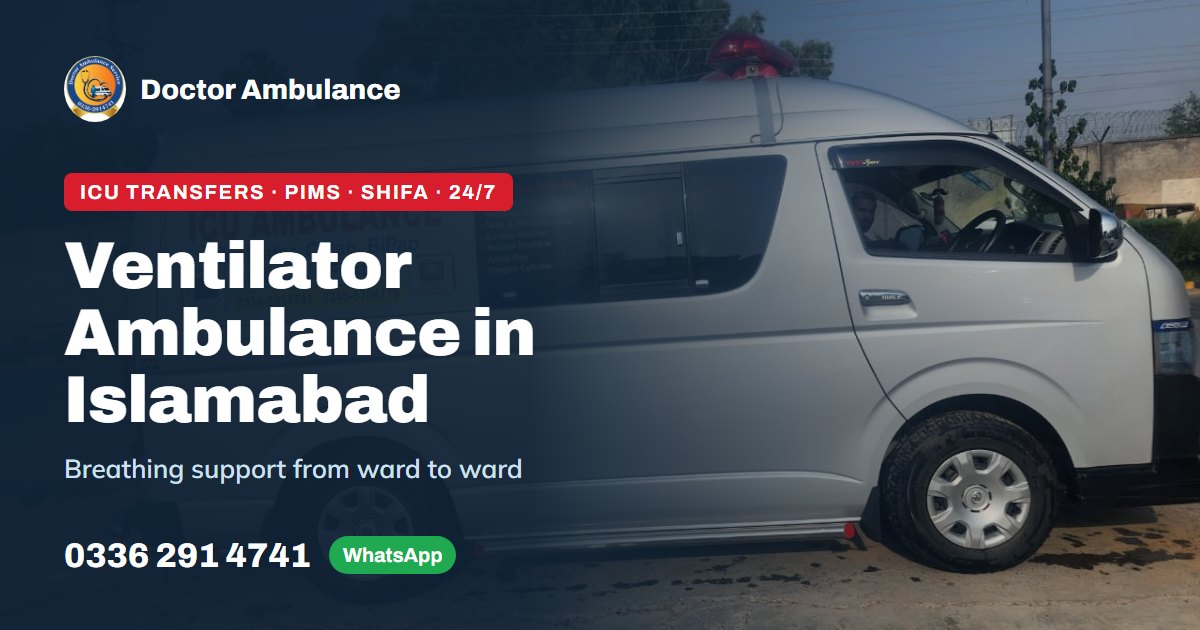
A ventilator ambulance is basically a small ICU on wheels. Ours carry an ICU-grade ventilator, CPAP and BiPAP support, oxygen cylinders, a cardiac monitor and pulse oximeter, a suction machine, an Ambu bag, and an auto-loader stretcher with a spine board. Trained staff travel with the patient and keep watching breathing, oxygen levels and heart rhythm from the ward to the handover. The full equipment list, with what each machine does, is on our main ventilator ambulance page.
Hospitals we move ventilator patients between in Islamabad
Most ventilator transfers in the capital involve the big ICUs. PIMS in G-8 has one of the largest public ICUs in the city. Shifa International Hospital in H-8 is a major private hospital with critical care. The Federal Government Polyclinic in G-6 serves many government employees and their families. There are also private hospitals in the F-sectors, Blue Area and along the Expressway, and many families move patients across to Rawalpindi hospitals like Holy Family or the Rawalpindi Institute of Cardiology.
The ambulance goes wherever the family and the doctors decide. If you live in one of the G-sectors, our guide on ambulance service in G-sectors Islamabad has practical tips on giving us your address quickly.
How to arrange a ventilator transfer in Islamabad, step by step
- Talk to the treating doctor. Ask whether the patient is fit to travel and whether a doctor or nurse from the ward will help with the handover.
- Confirm the bed. Make sure the receiving hospital has an ICU bed ready before the patient leaves. Moving a ventilated patient without a confirmed bed is the most common cause of delays.
- Call us early. Give us the patient’s condition, the ventilator or oxygen support they’re on, and both hospital names. Even an hour’s notice helps.
- Collect the papers: CNIC, transfer or discharge summary, recent reports, the current prescription and, if possible, the ventilator settings written down.
- One family member travels along. Pick the person who knows the patient’s history and has the papers.
Our crew connects the patient to our equipment at the bedside, checks everything is stable, and only then moves them. At the other end they stay until the receiving ICU team has taken over. For the paperwork side, see our checklist on hospital to hospital patient transfer.
Ventilator ambulance from Islamabad to other cities
Some patients need to go further: to a specialist in Lahore, home to Peshawar or Abbottabad, or to family in another city after a long ICU stay. On a long road trip a ventilator ambulance makes the biggest difference, because the patient stays on full support for hours. We plan these trips with the family and both hospitals before we leave. See our intercity ambulance service, and our route guides for Islamabad to Peshawar and Islamabad to Abbottabad.
Heart, stroke and accident patients
Many of the patients we move on a ventilator in Islamabad came in after a major heart attack, a large stroke or a road accident. In the first emergency the priority is reaching the nearest proper hospital fast. The ventilator transfer usually comes a day or two later, once the doctors have stabilised the patient. Our guides on the ambulance for heart attack patient and the ambulance for stroke patient explain what to do in those first minutes.
What does a ventilator ambulance in Islamabad cost?
A ventilator transfer costs more than a basic ambulance because of the equipment and trained staff. Inside Islamabad and Rawalpindi the main factor is distance. For intercity trips, it’s the distance and how many hours the patient needs support. Ask for the full price when you call so the family knows it before the trip. Our post on ambulance charges in Pakistan explains what changes the cost.
Ventilator ambulance in Islamabad: questions
Is a ventilator ambulance available at night in Islamabad?
Yes. We run 24 hours a day, seven days a week, holidays included.
Can you move a patient from PIMS to Shifa, or from Shifa to PIMS?
Yes. We move ventilated patients between any hospitals in Islamabad and Rawalpindi. Just confirm the ICU bed at the receiving hospital first.
Does the patient stay on the ventilator during the trip?
Yes. The crew moves the patient onto our ventilator at the bedside, so breathing support continues the whole way.
Can you take a ventilated patient from Islamabad to another city?
Yes. Tell us both hospitals and the patient’s condition, and call as early as possible so we can plan the trip.
How do I book?
Call 0336 291 4741 or 0345 570 4719, or send a WhatsApp message with both hospital names.
Keep our number saved: 0336 291 4741, or message us on WhatsApp. For everything else we offer in the capital, see our main page on ambulance service in Islamabad, and for the full equipment and booking details, our ventilator ambulance page.
Need an ambulance right now?
One call connects you to the nearest available vehicle. We dispatch immediately.