Rawalpindi has some of the busiest ICUs in the country. Patients come from across the city, from Chakwal, Jhelum, Murree and Azad Kashmir, and many of them later need to move: to a bigger ICU, to a specialist, or to a hospital closer to home. When that patient is on a ventilator, the move needs a ventilator ambulance. This guide explains how a ventilator ambulance in Rawalpindi works, which hospitals families usually move between, what you have to arrange, and how to keep the transfer safe.
Need one now? Call 0336 291 4741 or 0345 570 4719, or send a WhatsApp message with both hospital names.
Why Rawalpindi families need ventilator transfers
A few situations come up again and again in our calls from Pindi. A patient is admitted to a government hospital in an emergency, and once they’re stable the family wants to shift them to a private ICU, or the other way round because of cost. A heart patient at one hospital needs a procedure that’s only done at another. A patient from outside the city has spent weeks in a Rawalpindi ICU and the family wants them closer to home. In each case the patient can’t come off breathing support for the ride, so a normal ambulance won’t do.
Our base is at Chandni Chowk on Murree Road, in the middle of Rawalpindi, so the city’s main hospitals are close by. For everything else we do in the city, see our main page on ambulance service in Rawalpindi.
Hospitals we move ventilated patients between
In Rawalpindi, most ventilator transfers involve Holy Family Hospital in Satellite Town, Benazir Bhutto Hospital on Murree Road, the Rawalpindi Institute of Cardiology for heart patients, and the District Headquarters Hospital near Raja Bazar, along with private hospitals across the city, in Bahria Town and in DHA. Many patients also move across to Islamabad, to PIMS or Shifa International. The ambulance goes wherever the family and the doctors decide.
What’s on board
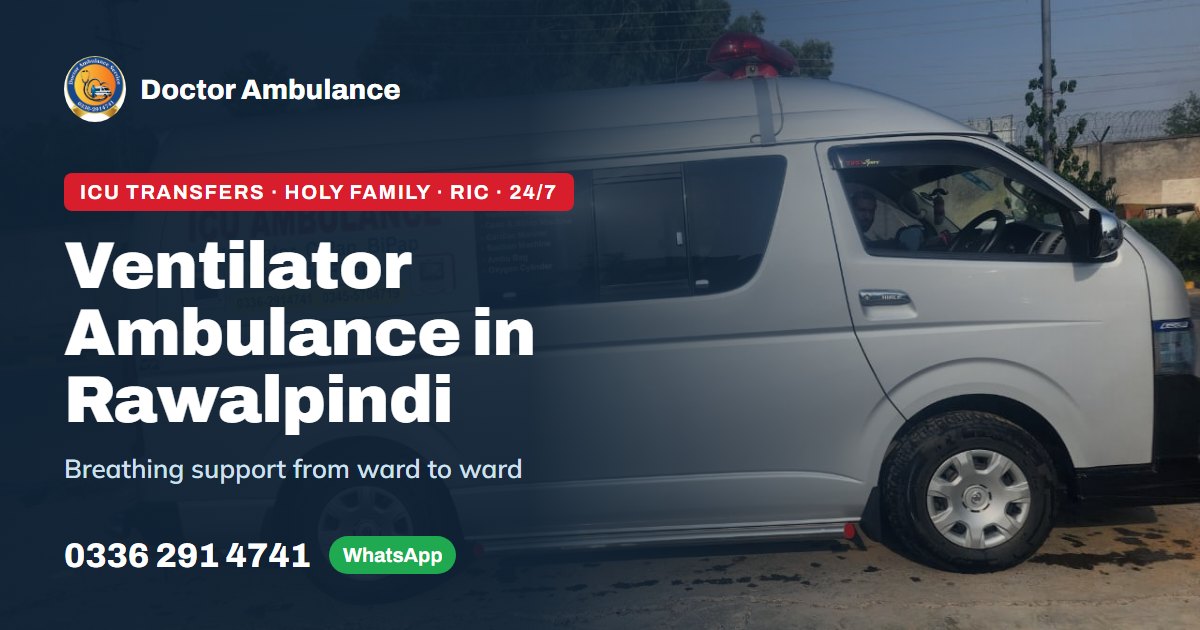
Our ventilator ambulance carries an ICU-grade ventilator, CPAP and BiPAP support, oxygen cylinders, a cardiac monitor, pulse oximeter, suction machine, Ambu bag, and an auto-loader stretcher with a spine board. Trained staff stay with the patient for the whole trip and watch breathing, oxygen and heart rhythm until the receiving ICU takes over. Each piece is explained on our main ventilator ambulance page.
How to arrange a ventilator transfer in Rawalpindi
- Ask the treating doctor whether the patient is fit to travel, and whether someone from the ward can help with the handover.
- Confirm an ICU bed at the receiving hospital before the patient leaves. This one step prevents most delays.
- Call us with the patient’s condition, the support they’re on, and both hospital names.
- Get the papers ready: CNIC, transfer summary, recent reports, prescription and the ventilator settings if possible.
- Choose one family member to travel along, ideally the person who knows the patient’s history.
The crew connects the patient to our ventilator at the bedside, checks that they’re stable, and only then moves them. Our checklist on hospital to hospital patient transfer covers the paperwork in more detail.
From Rawalpindi to Islamabad and other cities
The twin cities work as one, and a large share of our Rawalpindi ventilator trips end in Islamabad. If your patient is going there, our guide on the ventilator ambulance in Islamabad explains the hospitals and the handover, and our page on ambulance service in Islamabad covers the rest. For longer trips, see our intercity ambulance service and route guides like Rawalpindi to Lahore and Rawalpindi to Multan.
Does every critical patient need a ventilator ambulance?
No. A patient who is stable on a little oxygen can usually travel in an oxygen ambulance, which is simpler and costs less. The ventilator is for patients who need breathing support or very close monitoring. If you’re unsure, describe the patient on the call, or read our guide on which ambulance you need.
Cost of a ventilator ambulance in Rawalpindi
The price depends mainly on the distance and how long the patient needs support. Inside the twin cities the trip is short. Intercity trips cost more because the crew and equipment are out for hours. Ask for the full price when you call. Our post on ambulance charges in Pakistan explains what changes it.
Ventilator ambulance in Rawalpindi: questions
Is a ventilator ambulance available at night in Rawalpindi?
Yes. We work 24 hours a day, seven days a week, holidays included.
Can you move a patient from Holy Family or Benazir Bhutto Hospital to a private hospital?
Yes. We move ventilated patients between any hospitals in Rawalpindi and Islamabad. Confirm the ICU bed at the receiving hospital first.
Does the patient stay on a ventilator during the ride?
Yes. The crew moves the patient onto our ventilator at the bedside, so support doesn’t stop.
How do I book?
Call 0336 291 4741 or 0345 570 4719, or send a WhatsApp message with both hospital names.
Save our number: 0336 291 4741, or message us on WhatsApp. For every other service in the city, visit our page on ambulance service in Rawalpindi.
Need an ambulance right now?
One call connects you to the nearest available vehicle. We dispatch immediately.