When a doctor says “the patient needs an ICU ambulance”, most families have never booked one before. They don’t know what it is, how it’s different from a normal ambulance, what to ask on the phone, or what it should cost. This guide answers all of that in plain words. We run ICU ambulances in Rawalpindi and Islamabad every day and night, so everything here comes from real transfers, not theory.
Need an ICU ambulance right now? Call 0336 291 4741 or 0345 570 4719, 24/7, on call or WhatsApp.
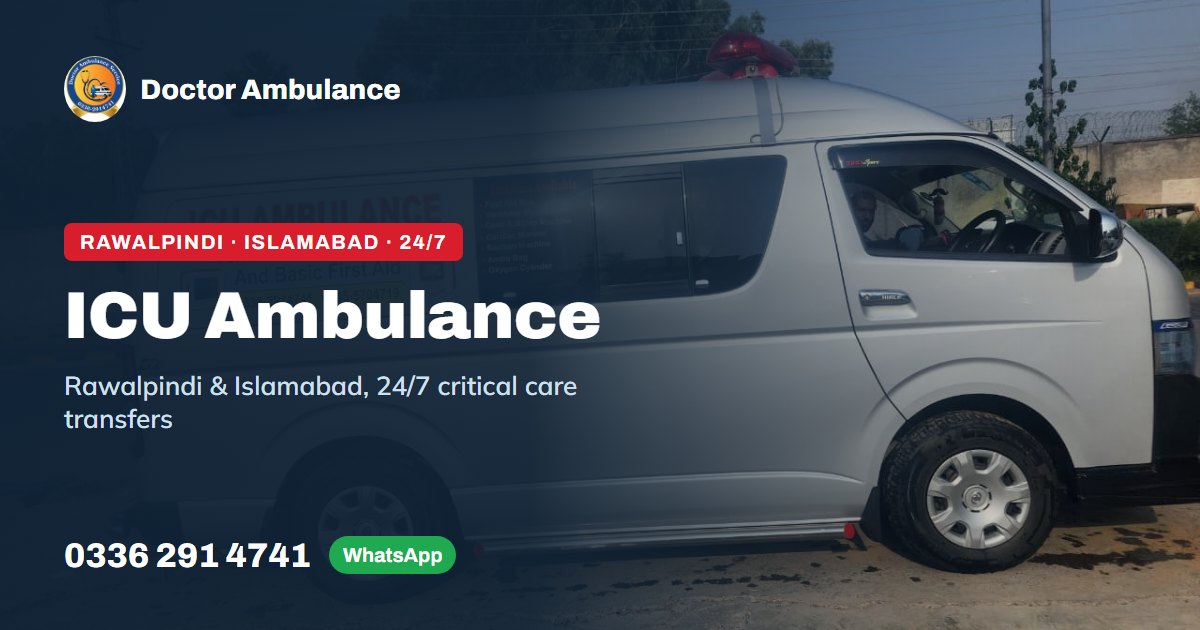
What is an ICU ambulance?
An ICU ambulance is an ambulance set up to keep a seriously ill patient safe on the road. A normal ambulance is mainly a way to carry a patient lying down. An ICU ambulance is closer to a small intensive care bed that moves. It carries the equipment to watch the heart and breathing every second, the oxygen and suction a critical patient may need, and trained staff who know what to do if the patient’s condition changes on the way.
People also call it a mobile ICU, a critical care ambulance or an ICU ventilator ambulance. The names overlap. What matters is not the name on the side of the vehicle but what’s inside it and who travels with the patient.
What’s inside our ICU ambulance
- Cardiac monitor: shows heart rate and rhythm all the time, so the crew sees a problem as soon as it starts.
- Pulse oximeter: shows the oxygen level in the blood.
- Oxygen supply: enough for the trip, checked before the ambulance leaves.
- Ventilator and CPAP/BiPAP: for patients who need help to breathe. Our ventilator ambulance page explains these in detail.
- Suction machine: clears secretions from the airway.
- Ambu bag: a hand-squeezed backup to breathe for the patient if needed.
- Auto-loader stretcher and spine board: to move the patient smoothly without pulling on lines and tubes.
And the most important part: trained medical staff who stay with the patient from the bedside at one end to the handover at the other.
ICU ambulance or a normal ambulance?
| Question | Normal ambulance | ICU ambulance |
|---|---|---|
| Who is it for? | A stable patient who needs to lie down | A serious or critical patient |
| Monitoring | Basic | Continuous heart and oxygen monitoring |
| Breathing support | Oxygen, if any | Oxygen, CPAP/BiPAP or a ventilator |
| Staff | Driver and helper | Trained medical staff with the patient |
| Typical use | Discharge home, check-ups | ICU to ICU, emergencies, long critical trips |
Not sure which one you need? Our guide on which ambulance you need compares every type, and you can always describe the patient on the call and let us suggest the right vehicle.
When do you need an ICU ambulance?
The treating doctor should make the final decision, but these are the usual reasons families book an ICU ambulance:
- The patient is in the ICU or CCU and is moving to another hospital
- The patient is on a ventilator, CPAP or BiPAP
- Low oxygen levels, or breathing that is getting worse
- A heart patient with chest pain, an irregular heartbeat or very low blood pressure
- A stroke patient who is drowsy or not fully awake
- An unconscious patient, or one who keeps passing out
- After major surgery, when close monitoring is still needed
- A long intercity trip for any patient who is not fully stable
For heart emergencies, read our guide on the ambulance for heart attack patient. For strokes, see the ambulance for stroke patient guide.
ICU ambulance in Rawalpindi
In Rawalpindi, many ICU transfers start or end at the big public hospitals: Holy Family Hospital in Satellite Town, Benazir Bhutto Hospital on Murree Road, the DHQ Hospital near Raja Bazar, and the Rawalpindi Institute of Cardiology on Rawal Road for heart patients. Just as many go to and from private hospitals in Saddar, Bahria Town and DHA. Our base is at Chandni Chowk on Murree Road, right on the city’s main road.
For everything we do in the city, see our main page on ambulance service in Rawalpindi. For hospital phone numbers, keep our list of hospitals in Rawalpindi handy.
ICU ambulance in Islamabad
In Islamabad, the common ICU routes run between PIMS in G-8, the Federal Government Polyclinic in G-6, Shifa International in H-8 and the private hospitals across the F, G, E and I sectors. Many patients also cross between the twin cities, for example from a Rawalpindi hospital to a specialist in Islamabad. We cover every sector and society, including DHA, Bahria Town and the schemes along the Expressway.
See our page on ambulance service in Islamabad, and our list of hospitals in Islamabad with phone numbers.
How to book an ICU ambulance
- Call or WhatsApp 0336 291 4741.
- Tell us where the patient is now: the hospital and ward, or your home address with a location pin.
- Tell us where they’re going. If it’s a hospital, confirm a bed first, especially an ICU bed.
- Describe the support the patient is on: ventilator, BiPAP, oxygen, drips, any pumps.
- Ask for the full price on the call before you book.
For a planned transfer, even an hour’s notice helps. For an emergency, just call, and give the rest of the details while the ambulance is on its way.
How families can help before the ambulance arrives
- Ask the treating doctor to confirm the patient is fit to travel.
- Get a short written summary: diagnosis, current medicines, and the ventilator or oxygen settings.
- Clear the bills and paperwork at the first hospital in advance.
- Keep the CNIC, old reports and the latest prescription in one bag.
- Decide which family member will travel in the ambulance. Usually one person can come along.
Our checklist for hospital to hospital patient transfer has the full list of papers.
What happens during the ride
At the bedside, the crew takes a handover from the ward staff and moves the patient onto our stretcher and equipment carefully, one step at a time. On the road, they watch the monitor, the oxygen level, the breathing and the lines the whole way. If something changes, they act right there. At the receiving hospital, they hand the patient and the papers over to the emergency or ICU team, and they only leave once that team has taken over. Our short guide on what happens after you call an ambulance walks through it step by step.
Intercity ICU ambulance
Sometimes a critical patient needs a specialist in another city, or the family wants them closer to home. A long trip is where an ICU ambulance matters most, because there are fewer hospitals along the motorway to stop at if something goes wrong. We plan these trips with the family and both hospitals before leaving: oxygen for the full distance plus extra, the right staff, and a confirmed bed at the other end. See our intercity ambulance service and our route guide for Rawalpindi to Lahore.
24 hour ICU ambulance
Critical patients don’t get worse on a schedule. Many of our ICU calls come at night, when a patient’s breathing gets worse at home or a hospital runs out of ICU beds. Our ICU ambulance runs 24 hours a day, seven days a week, holidays included. At night, keep the gate light on, send someone to the main road, and keep the phone line clear so the crew can call you for directions.
ICU ambulance price
An ICU ambulance costs more than a basic transfer, and it should, because of the equipment and the trained staff on board. The price mainly depends on:
- The level of support: ICU monitoring only, or a ventilator as well
- The distance, and one way or a return trip
- Waiting time, for example during a scan
- For long trips, the time the crew and vehicle are away
Give us the pickup point, the drop point and the patient’s condition, and we’ll tell you the full price on the call. Our guide to ambulance charges in Pakistan explains how to compare two quotes fairly, so you’re not comparing an ICU ambulance with a basic van.
ICU ambulance, oxygen ambulance or ventilator ambulance?
A patient who is stable and only needs a little oxygen usually travels well in an oxygen ambulance. A patient who needs close heart and oxygen monitoring needs an ICU ambulance. A patient who is on a ventilator, or may need one on the way, needs the ICU ambulance with a ventilator. If you’re not sure, our post on who needs a ventilator ambulance explains the signs doctors look for.
ICU ambulance for elderly patients
A large share of the ICU patients we move are older people: a parent with heart failure, a grandparent with a chest infection that turned into pneumonia, or someone recovering from a stroke. Older patients can get worse quickly, and they often have more than one illness at the same time. That makes monitoring on the way even more important. Bring the full list of medicines, including blood thinners and insulin, and tell the crew about any hearing problems or confusion so they can talk to the patient calmly. Our guide on the ambulance for elderly patients has more practical tips.
Taking an ICU patient home
Not every ICU transfer ends at another hospital. Sometimes a patient leaves the ICU to go home, either because they’ve improved and will continue care at home, or because the family has chosen to bring them home. In both cases the patient may still need oxygen and monitoring on the way. Before the trip, ask the hospital what equipment the patient will need at home, and arrange it before the ambulance arrives, not after. Make sure there’s a clear path from the gate to the bed, and tell us the floor and whether there’s a lift. Our guide on taking a patient home after hospital discharge covers this step by step.
Common mistakes families make
- Booking the cheapest vehicle for a critical patient. A basic van can’t keep a ventilated patient safe, whatever the price.
- Moving before the bed is confirmed. Arriving at a hospital that has no ICU bed means the patient waits in the ambulance or gets turned away.
- Leaving the papers behind. The new team needs the reports and the medicine list straight away.
- Not telling us everything. If the patient is on a ventilator, a pump or high oxygen, say so on the first call. It changes which ambulance we send.
- Waiting too long to call. If you know a transfer is coming, call early. It gives everyone time to prepare.
ICU ambulance number
Save our ICU ambulance number now: 0336 291 4741, or the second line 0345 570 4719. Both work 24/7 on call and WhatsApp. For the government emergency service, dial 1122. Our page on the ambulance number in Rawalpindi and Islamabad lists other useful numbers too.
ICU ambulance: questions families ask
What is an ICU ambulance?
An ambulance set up for seriously ill patients, with a cardiac monitor, oxygen, suction, breathing support and trained medical staff who watch the patient for the whole trip.
Is your ICU ambulance available 24 hours in Rawalpindi and Islamabad?
Yes. We run ICU ambulances in both cities 24 hours a day, seven days a week. Call 0336 291 4741.
Does the ICU ambulance have a ventilator?
Yes, when the patient needs one. Tell us on the call if the patient is on a ventilator, CPAP or BiPAP so we send the right setup.
How much does an ICU ambulance cost?
It depends on the level of support, the distance, any waiting time and whether it’s one way or a return trip. Ask for the full price on the call before booking.
Can you take an ICU patient to another city?
Yes. We plan intercity ICU transfers with the family and both hospitals, with oxygen for the full trip and a confirmed bed at the other end.
Need an ambulance right now?
One call connects you to the nearest available vehicle. We dispatch immediately.