Looking for an ambulance service in Faisalabad for a parent at home, a patient being discharged, or someone who needs a specialist in Lahore, Islamabad or Rawalpindi? Doctor Ambulance arranges emergency, oxygen, ICU and ventilator ambulances in Faisalabad and the towns around it, and we plan many intercity patient transfers to and from the city. One phone call is enough to get started.
Need help right now? Call 0336 291 4741 or 0345 570 4719, or message us on WhatsApp.
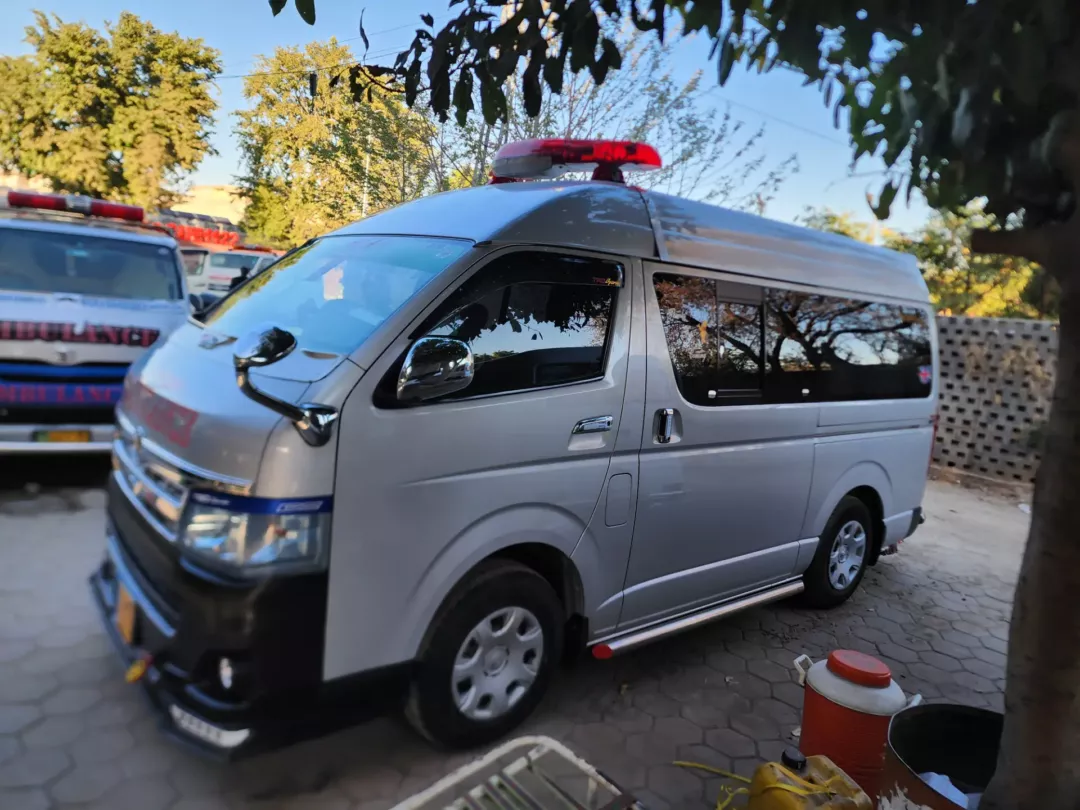
How to book an ambulance service in Faisalabad
- Call or WhatsApp us on 0336 291 4741.
- Give the full address and send a location pin.
- Tell us about the patient in your own words: awake or not, breathing okay or not, on oxygen or not.
- Tell us which hospital you want, if you already know.
That’s all we need to choose the right vehicle. Reports and the doctor’s name can be shared while the ambulance is on its way.
Finding you in Faisalabad
Faisalabad is a big, busy city, from the old bazaars around the Clock Tower (Ghanta Ghar) to newer areas like Madina Town, Peoples Colony, Gulberg, D Ground, Jinnah Colony, Susan Road, Canal Road and the housing schemes along Satiana Road and Jaranwala Road. The bazaars get very crowded, so in the old city send someone to the nearest main road to guide the crew. In gated colonies, tell the gate an ambulance is coming. A WhatsApp location pin is always the fastest way for the crew to find the house.
Ambulances we arrange in Faisalabad
- Emergency ambulance for sudden illness, falls and accidents at home
- Oxygen ambulance for patients with breathing trouble
- ICU and ventilator ambulance for critical patients, with trained staff
- Hospital to hospital transfer and home after discharge
- Intercity patient transfer to and from Rawalpindi, Islamabad and other cities
- Dead body transfer to the family’s home town
You don’t need medical words. Describe the patient and we’ll suggest the vehicle, or read our guide on which ambulance you need. For critical patients, see our ventilator ambulance page. If a family has lost someone, our dead body transfer ambulance guide explains what happens.
Hospitals families choose in Faisalabad
Faisalabad has large public hospitals, including Allied Hospital, the District Headquarters (DHQ) Hospital, the Faisalabad Institute of Cardiology for heart patients, the Children’s Hospital, and the Government General Hospital in Ghulam Muhammadabad, along with many private hospitals across the city. For some specialist and ICU care, families also move patients to Lahore, Islamabad or Rawalpindi. The ambulance goes wherever your family and the treating doctor decide. See our lists of hospitals in Rawalpindi and hospitals in Islamabad for the twin cities end.
Moving an admitted patient to another hospital needs a little paperwork and a confirmed bed. Our checklist on hospital to hospital patient transfer walks you through it, and our guide on taking a patient home after discharge covers the trip home.
Faisalabad to Rawalpindi and Islamabad
Faisalabad is a long drive from the twin cities, so we plan every trip as an intercity transfer, with oxygen ready for the whole journey and trained staff with the patient. A patient who can’t sit up, is breathless or very weak should make this trip lying down, never squeezed into a car. Our intercity ambulance service page explains how we plan long transfers. Our home base is the twin cities, so see our ambulance service in Rawalpindi and ambulance service in Islamabad pages for the other end of the trip.
Emergency ambulance in Faisalabad: the first minutes
When someone collapses, has chest pain, can’t breathe properly or has had a bad fall, the first few minutes matter most. Call for an ambulance first, then do the simple things while you wait. Keep the patient still and comfortable. Loosen tight clothes. If they’re not breathing normally, start CPR and keep going until the crew takes over. Don’t give food or water to someone who is drowsy or confused. Put the patient’s CNIC, reports and medicines in one bag so nothing is forgotten.
For a heart attack or a stroke, time decides a lot. Our guides on the ambulance for heart attack patient and the ambulance for stroke patient explain the warning signs and which hospital to choose. Our guide on first aid before the ambulance arrives covers the basics in plain words.
ICU ambulance in Faisalabad
An ICU ambulance is for a patient who is seriously ill and needs close watching on the way: someone on a heart monitor, someone whose oxygen keeps dropping, or someone moving from one ICU to another. It carries a cardiac monitor, oxygen, suction and emergency equipment, and trained staff stay with the patient for the whole trip. In Faisalabad, families most often book an ICU ambulance to move a patient from a local hospital to a bigger ICU in Rawalpindi, Islamabad or Lahore. Before the patient leaves, confirm the ICU bed at the receiving hospital. That one step prevents most delays.
Ventilator ambulance in Faisalabad
A ventilator ambulance is needed when the patient can’t breathe well enough on their own and needs a machine to support them. The crew connects the patient to our ventilator at the bedside, checks that they’re stable, and only then moves them, so breathing support never stops. This is the most serious kind of transfer, and it needs a clear plan between the two hospitals. Our ventilator ambulance page explains the equipment, and our guide on who needs a ventilator ambulance explains when doctors ask for one.
Oxygen ambulance in Faisalabad
Many patients don’t need a ventilator but do need oxygen on the way: people with asthma, COPD, pneumonia, heart failure, or anyone already on oxygen at home. An oxygen ambulance carries enough oxygen for the trip, and for long intercity journeys we plan extra so it never runs short. If the patient uses oxygen at home, tell us the flow rate the doctor has set, and we’ll match it.
Private ambulance in Faisalabad or Rescue 1122?
Rescue 1122 does excellent work in Punjab, especially at road accidents and emergencies in public places, and it usually takes the patient to the nearest government hospital. A private ambulance in Faisalabad is a different kind of help. The family chooses the hospital, in Faisalabad or in another city. You can book a planned trip for a discharge, dialysis or a scan, and you can arrange an ICU or ventilator transfer to Rawalpindi, Islamabad or Lahore with one company from start to finish. Our guide on Rescue 1122 or a private ambulance compares them honestly.
24 hour ambulance in Faisalabad
Emergencies don’t wait for the morning. Our lines are answered 24 hours a day, every day, including Eid and public holidays. Night calls are handled the same way as day calls: tell us the address and the patient’s condition, send a location pin, and switch on the outside light so the crew can find the house. For planned trips at odd hours, such as an early dialysis slot or a late discharge, call a day ahead and we’ll plan it.
Faisalabad to Islamabad and Rawalpindi ambulance
Faisalabad to Islamabad and Faisalabad to Rawalpindi trips usually go up the M-4 motorway to Pindi Bhattian and then north on the M-2. The motorway is smoother for a patient lying down, but it’s still a long journey, so we plan it properly: oxygen for the full trip plus extra, a stop plan if the family needs one, and a confirmed bed before we leave. Many families make this trip to reach PIMS, Shifa International, the Rawalpindi Institute of Cardiology or a specialist they already see in the twin cities.
Before a long transfer, ask the treating doctor whether the patient is fit to travel and what support they need on the way. Then confirm the bed at the receiving hospital, collect the papers, and choose one family member to ride along. Our lists of hospitals in Rawalpindi and hospitals in Islamabad have their main phone numbers, so you can call ahead.
Faisalabad to Lahore ambulance
Faisalabad to Lahore is the trip Faisalabad families ask for most, because many specialists and big teaching hospitals are in Lahore. It’s shorter than the run to the twin cities, but a critical patient still needs proper support on the way. See our page on ambulance service in Lahore for the Lahore end. For nearby cities, see our pages on ambulance service in Sargodha and ambulance service in Multan.
Dead body ambulance in Faisalabad
When a family loses someone away from home, bringing them back is hard enough without worrying about transport. We arrange dead body transfer from Faisalabad to the family’s home town, and from other cities back to Faisalabad, with a respectful crew who help with the loading and the journey. Tell us where the body is, where it needs to go, and when the family wants to leave. Our dead body transfer ambulance guide explains the papers and the steps.
Ambulance for elderly patients in Faisalabad
A large share of our bookings from Faisalabad and nearby towns like Jaranwala, Samundri, Tandlianwala, Chak Jhumra and the villages of the district are for older parents. Some are emergencies, but many are planned: a hospital visit, a scan, dialysis, or coming home after an operation. A weak patient is safer lying on a stretcher than sitting up in a car for a long drive. Our guide on the ambulance for elderly patients has practical tips for families.
Patient transfer from Faisalabad: a short checklist
- The doctor’s go-ahead, and what support the patient needs on the way
- A confirmed bed at the receiving hospital, especially for an ICU
- Referral or discharge summary, recent reports, scans and the medicine list
- The patient’s CNIC and the attendant’s phone number
- Hospital bill settled, so the patient can be released on time
- One family member ready to travel with the patient
Mistakes families make, and how to avoid them
- Putting a weak patient in a car. It feels quicker, but a patient who can’t sit up, is breathless or has had a fall can get worse on the way. Lying down with trained staff is safer.
- Leaving without a confirmed bed. Arriving at a big hospital in another city with no bed arranged can mean hours of waiting at the emergency gate. Call ahead first.
- Forgetting the papers. Without the reports and medicine list, the new hospital may repeat tests and lose time.
- Not asking the full price. Ask for the total cost on the call, one way or return, so there are no surprises later.
- Waiting too long to call. If you’re unsure whether it’s serious, call and describe the patient. It’s better to ask early than late.
Ambulance number for Faisalabad
Save our number today, in your phone and your parents’ phones: 0336 291 4741, with a second line on 0345 570 4719. Both are answered 24/7, and both work for WhatsApp messages with a location pin. For other emergency services such as police and fire, see our list of emergency numbers in Pakistan.
What does an ambulance cost in Faisalabad?
The price depends on the type of ambulance, the distance and whether staff travel with the patient. A short trip in a basic ambulance costs much less than a long ICU transfer. Ask for the full price on the call before you book. Our post on ambulance charges in Pakistan explains what changes it.
Ambulance service in Faisalabad: questions
Can you move a patient from Faisalabad to Islamabad or Rawalpindi?
Yes. We plan Faisalabad to Islamabad and Rawalpindi transfers as intercity trips, with oxygen for the whole journey and trained staff. Confirm the bed at the receiving hospital before the patient leaves.
Do you do Faisalabad to Lahore ambulance trips?
Yes. Faisalabad to Lahore is a common route for specialist care. Tell us the patient’s condition and the hospital when you call.
Do you cover Jaranwala, Samundri, Tandlianwala and Chak Jhumra?
Yes. We cover Faisalabad city and the towns of the district. Send a WhatsApp location pin so the crew can find you.
How do I book an ambulance service in Faisalabad?
Call 0336 291 4741 or 0345 570 4719, or send a WhatsApp with your location pin.
What is the ambulance number in Faisalabad?
Call Doctor Ambulance on 0336 291 4741 or 0345 570 4719, 24/7. You can also send a WhatsApp message with your location pin.
Do you provide a dead body ambulance in Faisalabad?
Yes. We arrange dead body transfer from Faisalabad to the family’s home town, and from other cities back to Faisalabad.
Is your ambulance in Faisalabad available 24 hours?
Yes. Our lines are answered 24 hours a day, every day, including Eid and public holidays.
Can I book a planned trip from Faisalabad?
Yes. For discharges, dialysis or scans, call a day ahead with the time and the hospital, and we’ll plan the pickup and return.
Need an ambulance right now?
One call connects you to the nearest available vehicle. We dispatch immediately.