The G-sectors are the busy heart of everyday Islamabad. From the old government flats of G-6 and G-7 to the crowded markets of G-9 and G-10 and the newer streets of G-13 and G-14, thousands of families live here, and some of the city’s most important hospitals sit right in the middle of it. When someone at home suddenly can’t breathe properly, collapses, or needs to be moved to PIMS in a hurry, the family needs one number they can trust. This guide explains how our ambulance service in G-sectors Islamabad works, what to say on the phone, how to help the crew find your house quickly, and how to choose the right hospital and the right ambulance.
If this is an emergency, don’t keep reading. Call 0336 291 4741 or 0345 570 4719 now, or send a WhatsApp message with your location pin.
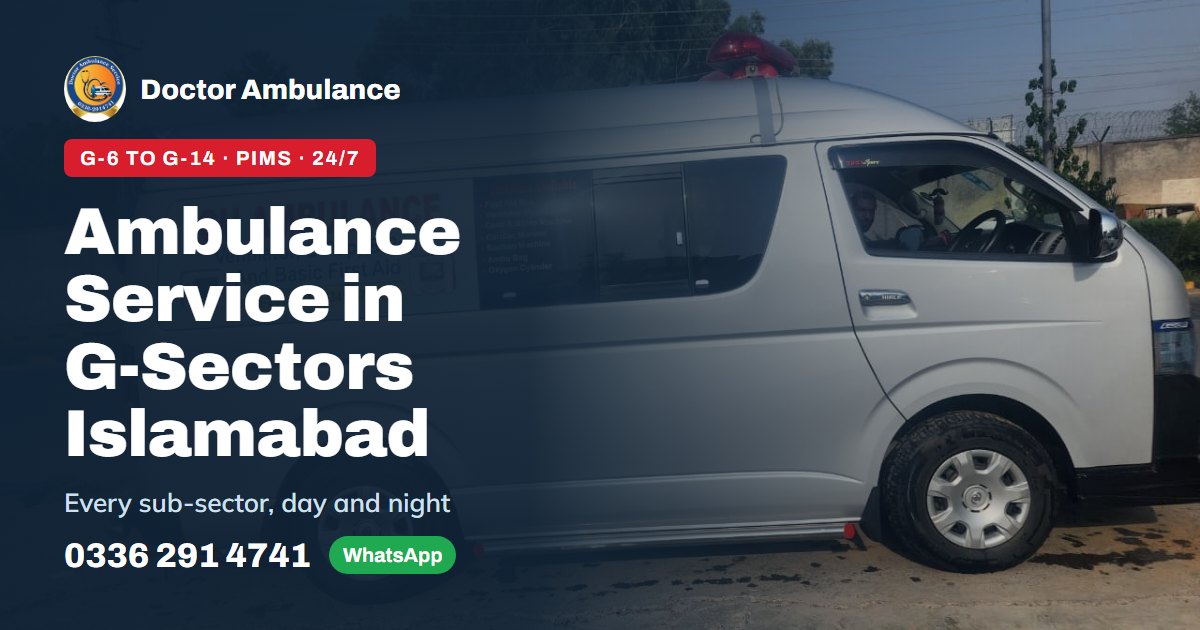
Why the G-sectors need a little planning
Islamabad looks neat on a map, but anyone who lives here knows it can be confusing in a hurry. Every sector is split into four sub-sectors, so G-9 becomes G-9/1, G-9/2, G-9/3 and G-9/4, and each one has its own streets and house numbers. Many houses also have upper portions and basements rented to different families. A driver who isn’t told the exact sub-sector can end up on the right street in the wrong part of the sector.
The markets add another layer. Karachi Company in G-9, G-10 Markaz, G-11 Markaz and Sitara Market in G-7 are packed for most of the day, and parking spills onto the service roads. None of this stops an ambulance, but it changes what you should tell us on the call. Our crews come into Islamabad from our base on Murree Road every day, and they know these sectors well. For everything we cover across the capital, see our main page on ambulance service in Islamabad.
How to book an ambulance service in G-sectors Islamabad
A clear, calm call saves more time than anything else. Give us the details in this order:
- Call or WhatsApp 0336 291 4741. If it’s busy, call 0345 570 4719.
- Say the full address the Islamabad way: sector and sub-sector, street number and house number, for example “G-10/2, Street 5, House 12”.
- Tell us the portion: ground floor, upper portion or basement, and whether there’s a separate gate.
- Give a landmark: the markaz, a mosque, a school, a park, or a well-known shop nearby.
- Send a WhatsApp location pin. It removes all guesswork about sub-sectors.
- Describe the patient: age, what happened, whether they’re awake and breathing normally, and any heart, sugar or blood pressure problems.
- Tell us the hospital you want, or ask us and we’ll help you decide.
Not sure whether to call us or the government service? Our guide on Rescue 1122 or a private ambulance explains when each one makes sense.
Help the crew reach your door
The last few hundred metres are where most time is lost. A few small steps from your side help a lot:
- Send one person to the nearest main road or the corner of your street to wave the ambulance in.
- At night, switch on the gate light and open the gate before the crew arrives.
- If you live near a busy markaz, ask a neighbour to keep the front of the house clear of parked cars.
- In flats and upper portions, clear the stairway so the stretcher can pass.
- Keep your phone on loud, because the crew may call to confirm a turn.
Please don’t try to carry a patient who has fallen or collapsed down the stairs yourselves. The wrong grip can make an injury worse. Our crew is trained to bring patients down safely on a stretcher, even from narrow staircases in older G-6 and G-7 flats.
Hospitals in and near the G-sectors
The G-sectors are lucky to have two of the capital’s biggest public hospitals inside them. PIMS (Pakistan Institute of Medical Sciences) is in G-8 and has a large emergency department along with specialist wards and a children’s hospital. The Federal Government Polyclinic is in G-6, close to Aabpara. Shifa International Hospital is just across the road in H-8, and there are many private hospitals in the F-sectors and Blue Area that families also choose.
The ambulance goes wherever the family decides. A simple rule helps: if the patient already sees a specialist at one hospital, that’s usually the best place, because the records and the doctor are already there. For chest pain, go to a hospital with a cardiac emergency open around the clock, and read our guide on the ambulance for heart attack patient. For a drooping face, weak arm or slurred speech, choose a hospital with a CT scan, as we explain in our guide on the ambulance for stroke patient.
Which ambulance to ask for
You don’t need medical words. Describe the patient and we’ll suggest the right vehicle:
- Basic ambulance: for a stable patient going for a check-up, a scan, or home after discharge.
- Oxygen ambulance: for breathlessness, asthma, COPD, or a patient who already uses oxygen at home.
- ICU or ventilator ambulance: for a critical patient who needs close monitoring or breathing support. See our page on the ventilator ambulance.
Still unsure? Our simple guide on which ambulance you need compares each option in plain words.
Planned trips: dialysis, scans and discharge
Not every call is an emergency. Many G-sector families book us for planned trips: an elderly parent going to PIMS for dialysis, a patient who needs an MRI but can’t sit up in a car, or someone coming home after an operation. Lying on a stretcher is safer and much more comfortable for a weak patient than a long ride in a car seat. If you care for an older parent, our guide on the ambulance for elderly patients has practical tips.
For a discharge, call us a day ahead with the time and the ward. Our checklist on taking a patient home after hospital discharge covers the papers, medicines and home setup you’ll need before the patient arrives.
Keep a ready bag at home
In an emergency, families lose precious minutes looking for papers. If someone at home is elderly or has a long-term illness, keep one bag near the door with:
- The patient’s CNIC and a photocopy
- Recent reports, discharge summaries and the latest prescription
- A written list of current medicines, especially blood thinners and insulin
- A phone charger and some cash
- Our number written on paper, in case a phone battery dies
While you wait, keep the patient still and comfortable and loosen tight clothes. If they stop breathing normally, start CPR and keep going until the crew takes over. Our guide to first aid before the ambulance arrives walks you through it.
Transfers to Rawalpindi and other cities
The twin cities work as one, and many G-sector patients are treated in Rawalpindi too, at hospitals like Holy Family, Benazir Bhutto or the Rawalpindi Institute of Cardiology. We handle those trips every day. See our ambulance service in Rawalpindi page for details. If a patient is admitted and needs to move to a bigger hospital, our notes on hospital to hospital patient transfer explain what to arrange. For longer journeys, such as Islamabad to Peshawar, see our intercity ambulance service.
What does it cost?
The price depends on the type of ambulance, the distance, and whether the patient needs oxygen or ICU support on the way. Ask for the full price when you call, so there are no surprises. Our post on ambulance charges in Pakistan explains what changes the cost.
Ambulance service in G-sectors Islamabad: questions
Which G-sectors do you cover?
All of them, including G-5, G-6, G-7, G-8, G-9, G-10, G-11, G-12, G-13, G-14 and G-15, along with nearby markets like Aabpara, Sitara Market and Karachi Company.
Can you take the patient to PIMS or the Polyclinic?
Yes. Tell us the hospital when you call and we’ll take the patient there, or to any other hospital the family chooses, in Islamabad or Rawalpindi.
We live in an upper portion and the patient can’t walk. Can you help?
Yes. Tell us the floor and how wide the stairs are, and our crew will bring the patient down safely on a stretcher.
Can I book a planned trip for dialysis or a scan?
Yes. Call us a day ahead with the time and the hospital, and we’ll plan both the pickup and the return.
Do you work at night and on holidays?
Yes. We work 24 hours a day, seven days a week, holidays included.
How do I book?
Call 0336 291 4741 or 0345 570 4719, or send a WhatsApp message with your location pin.
Save our number today, in your phone and your parents’ phones: 0336 291 4741, or message us on WhatsApp. For the other sectors, areas and hospitals we cover, visit our main page on ambulance service in Islamabad.
Need an ambulance right now?
One call connects you to the nearest available vehicle. We dispatch immediately.