Most calls we get at night are not about accidents. They are about an elderly parent or grandparent. Abba ji fell in the bathroom, Ammi’s sugar dropped, Dada ji is breathing fast and won’t wake up properly. If you live with an older person, this guide is for you. It explains when to book an ambulance for elderly patients, how to move them safely, and what to keep ready so the trip is calm.
If it’s happening right now, call 0336 291 4741 or 0345 570 4719 first. Read the rest later.
Why a car is often not enough
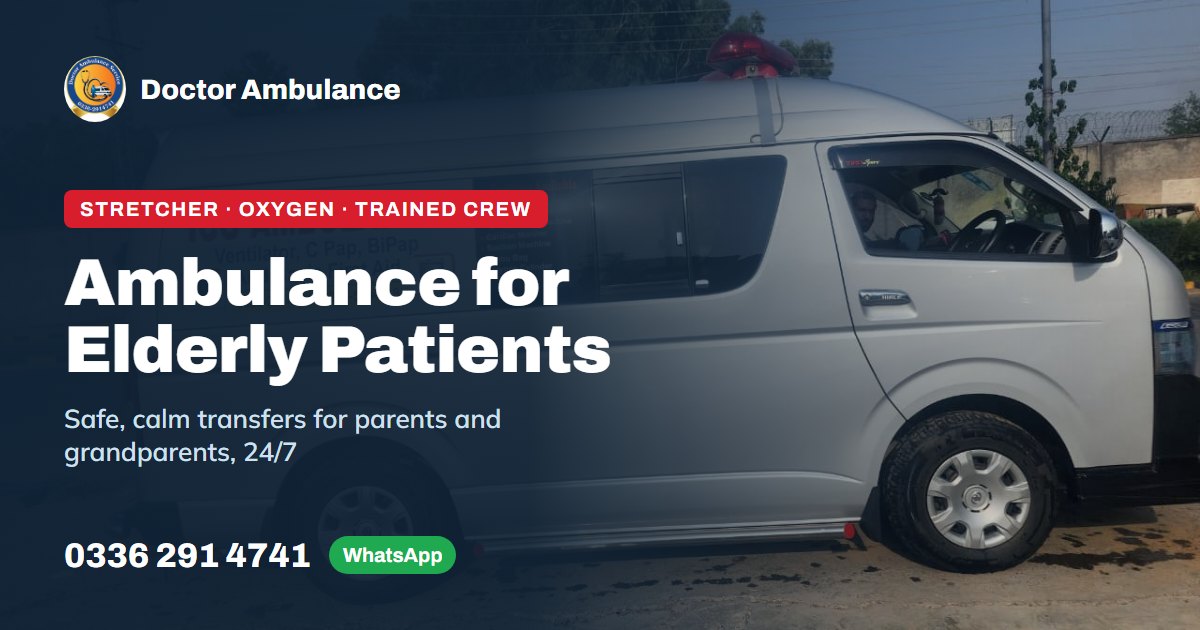
Families try the car first, and we understand why. But older patients are hard to move. A stiff hip, a weak heart or a recent fall can turn a short trip into a painful one. Lifting someone into a back seat can hurt them, and it can hurt the person lifting too. A patient who needs oxygen at home will also need it on the road. In an ambulance the patient lies flat on a stretcher, oxygen is on board, and the crew knows how to carry them down narrow stairs without twisting them.
Signs you should book an ambulance for elderly patients
- A fall, and now they can’t stand or the hip or leg hurts badly
- Sudden confusion, slurred speech, or one side of the face or body feels weak
- Chest pain, or breathing that is fast, noisy or tired
- Very low or very high sugar and they are drowsy
- They are too weak to sit up in a car
- They use oxygen at home and need to go to hospital
Weakness on one side or slurred speech can mean a stroke. Don’t wait to see if it passes. Time matters a lot here. If you’re not sure which vehicle fits, our guide on which ambulance you need explains each type simply.
What to tell us on the call
Keep it short. We need the address, the patient’s age, and what you see: awake or not, breathing okay or not, any fall or pain. Tell us if they use oxygen, have a heart problem, or are on dialysis. Tell us the floor too. A third floor flat with a narrow staircase needs a different plan from a ground floor house. Our ambulance service in Rawalpindi and our ambulance service in Islamabad both run 24 hours, so call at any hour.
Keep this bag ready
Older patients usually have a lot of history, and doctors ask for it straight away. Keep one bag near the door with:
- CNIC and any hospital card
- The latest reports and discharge papers
- A written list of all medicines and doses
- Glasses, dentures, hearing aid and a shawl
- A charged phone and one family member who knows the history
This one bag saves a lot of running around at the emergency desk.
While you wait for the crew
If they fell, don’t pull them up. Make them comfortable where they are with a pillow and a blanket. If they’re drowsy, don’t give food or water, because they may choke. Turn them on their side if they vomit. If they stop breathing normally, start CPR and keep going. The basic steps are in our guide to first aid before the ambulance arrives.
Planned trips: check-ups, scans and dialysis
Not every trip is an emergency. Many families book us for planned visits, like a scan, a follow-up, or regular dialysis, because the patient can’t sit in a car for long. Call a day before if you can. Tell us the hospital and the appointment time, and we’ll plan the pickup so you’re not rushing. Bringing a parent home from hospital is the same kind of job. Our checklist on taking a patient home after discharge covers it.
When the patient is critical
Sometimes an older patient needs more than oxygen. If the doctor says the patient is critical, or they’re already on a ventilator, ask for an ICU ambulance with trained staff. You can read about it on our ventilator ambulance page. For moving a patient between two hospitals, see our notes on hospital to hospital patient transfer.
A few words for the family
Older people often say “I’m fine, don’t call anyone.” They don’t want to be a burden. Be gentle but firm. It’s much better to call and find it was nothing than to wait too long. Talk to them calmly during the trip and hold their hand. A familiar voice helps more than you’d think.
Ambulance for elderly patients: questions
Can a family member ride with the patient?
Yes. One family member can usually travel with the patient. Tell us on the call.
Can you carry a patient down stairs?
Yes. Tell us the floor and how wide the stairs are, and the crew will come ready to carry the patient safely.
Do you take elderly patients for dialysis or scans?
Yes. Planned trips are fine. Call a day before with the hospital name and appointment time.
Is oxygen available in the ambulance?
Yes. Tell us if the patient uses oxygen at home so the right supply can be planned.
How much does it cost?
It depends on the ambulance type and the distance. Ask for the full price on the call. Our post on ambulance charges in Pakistan explains what changes it.
Save our number in your parents’ phone and yours: 0336 291 4741, or message us on WhatsApp.
Need an ambulance right now?
One call connects you to the nearest available vehicle. We dispatch immediately.