Murree is where half of Islamabad and Rawalpindi goes to cool off. Lots of people, steep roads, cold nights, and in winter, snow. Most trips are fine. But every season we get the same calls: someone’s father felt chest pain at the hotel, a child fell on the Mall Road slope, a car slid on the ice near the expressway. The local hospital can stabilise them, and then the patient needs to come down to a bigger hospital in the city.
This guide is about that trip. How a Murree to Islamabad ambulance works, what slows it down, and what you can do while you wait.
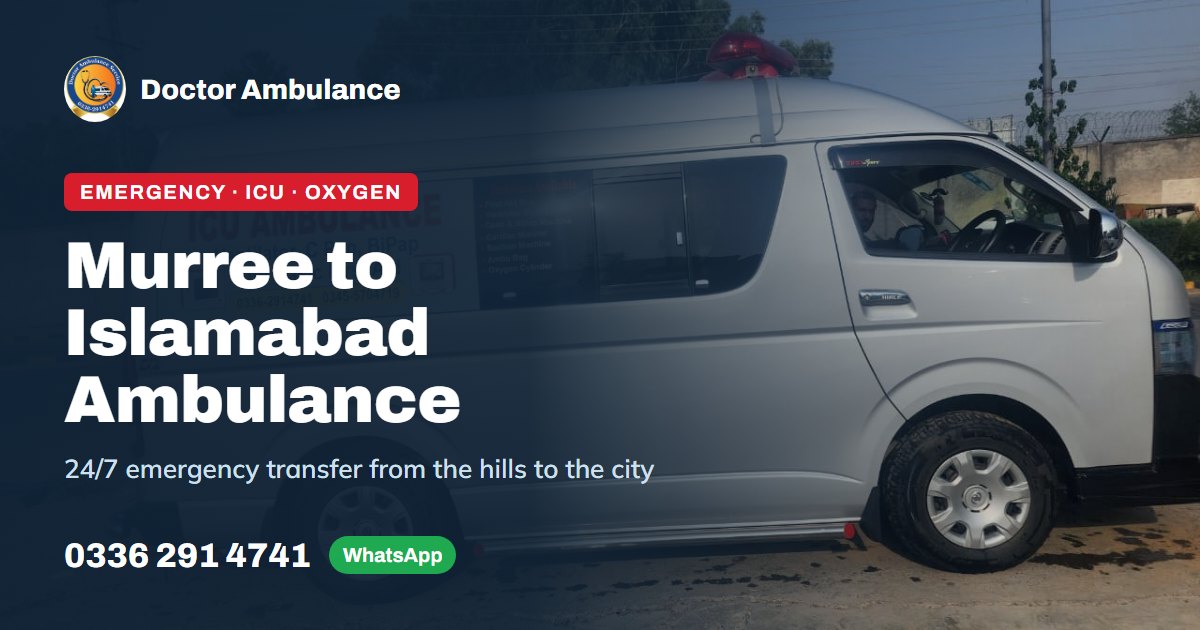
When you need a Murree to Islamabad ambulance
The common cases we see from the hills:
- Chest pain or a heart problem, often in older people after a long day walking uphill
- Breathing trouble in the cold, especially in people with asthma or chest disease
- Falls and fractures on wet or icy slopes
- Road accidents on the hill roads
- A patient admitted locally who now needs a scan, specialist or ICU bed in the city
If it’s a real emergency (someone has collapsed, isn’t breathing, or is bleeding badly) call Rescue 1122 or the nearest help first. Getting the patient to the closest hospital comes before anything else. Our job usually starts after that, moving them down to Islamabad or Rawalpindi once they’re stable enough.
How to book it
Call 0336 291 4741 or message us on WhatsApp. Murree addresses can be confusing for anyone who doesn’t know the town, so a WhatsApp location pin helps a lot. Tell us where the patient is (hotel, house or hospital), where they need to go, and how they are right now.
Our ambulance service in Murree page has more about what we cover up there.
Which ambulance to ask for
Same rule as anywhere. Match the vehicle to the patient. A fracture patient who’s stable needs a stretcher and a smooth ride. A heart patient needs a cardiac monitor. Someone struggling to breathe in the cold needs oxygen the whole way down. A critical patient needs an ICU or ventilator ambulance. Not sure? Read which ambulance you need, or just describe the patient to us.
How long the trip takes, and what slows it
On a normal day, Murree to Islamabad on the Murree Expressway takes roughly an hour to an hour and a half. On a busy weekend or a holiday, it can be a lot slower, because the traffic jams going up and coming down are real.
Snow is the other big one. In heavy snowfall, parts of the road can slow to a crawl or close for a while. Our drivers know these roads, but honestly, nobody controls the weather. If snow is forecast and the patient’s transfer can wait a few hours for the road to clear, that’s sometimes the safer choice. The treating doctor is the right person to decide that.
While you wait for the ambulance
Keep the patient warm. Cold makes almost every problem worse, from heart strain to shock after an injury. Use blankets, close windows, and keep them off the cold floor. Don’t give food or water to anyone who’s drowsy. Our guide on first aid before the ambulance arrives covers CPR, bleeding and the recovery position in simple steps.
Collect the patient’s ID card, any reports from the local hospital and their regular medicines in one bag. If the hotel staff can send someone to the road to guide the ambulance in, even better.
Where patients go in the city
Most families choose a hospital in Islamabad or Rawalpindi, often closer to where they live. Call the hospital ahead if you can so they know a patient is on the way. Our checklist for hospital to hospital patient transfer helps if the patient is moving from the Murree hospital to one in the city.
Cost
It depends on the ambulance type and the exact pickup and drop points. Ask for the full price when you call. Our post on ambulance charges in Pakistan explains what changes the price.
Murree to Islamabad ambulance: common questions
How long does an ambulance take from Murree to Islamabad?
Roughly an hour to an hour and a half on the Murree Expressway on a normal day. Weekend traffic and snow can make it much slower.
Can you pick up a patient from a hotel in Murree?
Yes. Send us the hotel name and a WhatsApp location pin so the crew finds it quickly.
Do you run in winter when it snows?
We work 24/7, but heavy snow can slow or close parts of the road. We’ll tell you honestly what the road looks like when you call.
Is an oxygen or ICU ambulance available for this route?
Yes. Tell us the patient’s condition and we’ll send an oxygen, cardiac, ICU or ventilator ambulance as needed.
Can a family member come along?
Usually one family member can travel with the patient.
Save our number before your Murree trip: 0336 291 4741 or 0345 570 4719. You can also reach us on WhatsApp.
Need an ambulance right now?
One call connects you to the nearest available vehicle. We dispatch immediately.